Manhood
August 12, 2026
Julia Roberts
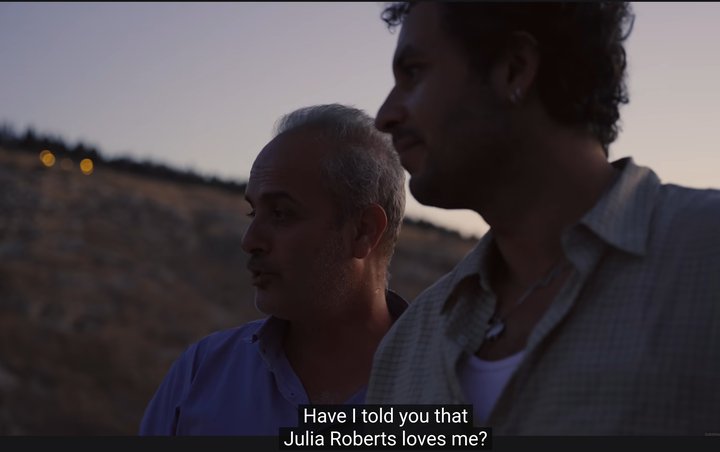
Kareem, the SubwayTakes guy, has just released a city symphony film in and about Damascus. I watched it glued to my seat. The production, cinematography, and commentary were sublime. But what elevates it far above is Kareem's tour guide and the movie's protagonist, a wise, romantic taxi driver. Paradoxically, the tour guide's name is Bashar, the same name as Syria's disgraced, ousted president, who brought on our tour guide most of his misfortunes. Bashar and Kareem quip about many things, from absurd make-believe to the more absurd reality.
Bashar oozes charisma and wit throughout the film. He overflows with humanity and humor as well. He jokes about FedEx and UPS, talks about history and faith, stares into his destroyed childhood home, and discusses movies and their stars -- he loves Julia Roberts, he says: "She is number one for all the boys." He gets teary-eyed about Damascus every time. Kareem calls him a romantic; Bashar replies: "thank you thank you thank you."
Standing atop Mount Qassioun and overlooking Damascus, Bashar admits to Kareem that Julia Roberts is in love with him. "She called me so many times, but I ignored all her calls." Kareem finds only one issue: Julia Roberts is in fact in love with him instead, so she cannot be in love with Bashar.
Gina Lollobrigida
Mustafa Tlass was Syria's minister of defense for 32 years. During his tenure, the Syrian army and security forces killed 40,000 Syrians in the Hama massacre. They occupied and terrorized Lebanon, besieging and bombarding towns. Tlass claimed he gave the green light to the horrendous terrorist attack on the US Marine barracks in Beirut.
Tlass fashioned himself as an enlightened warrior. In whatever free time he had between murder and terrorism, he wrote books on history, poetry, theology, justice, and global liberation movements. He also enjoyed giving wild press statements and interviews where he would make ridiculous, unhinged claims.
In one such interview in 1998, he claimed that he stopped a planned attack on Italian soldiers in Lebanon because he did not want "a single tear falling from the eyes of Gina Lollobrigida," a beautiful Italian actress and model.
Tlass, it turns out, had been in love with Gina since his youth. Luckily for him, she was in love with him as well, or so he says. In another interview, he claims Gina had sent him a letter telling him he was the love of her life.
Tlass made more fantastical claims about many other women. Sometimes he was in love with Marilyn Monroe or Madonna. At other times, Lady Diana was writing him letters full of love and admiration. Gina, however, was the only constant fixture.
Monica Bellucci
I first heard about Tlass's delusions from my father, who despised Tlass with all his heart. My father could not stomach Tlass's crimes or his central role in Syria's descent into oppression. But above all else, my father hated him for his taste in women: after telling me this story, my father followed up with "[Tlass] could have at least chosen Monica Bellucci."
My father loved Monica Bellucci. He spoke about her many times. In fact, I owe a great deal to her and to my dad's preoccupation with her. My mother was opposed to movies and would not let us watch any at home. This changed in 2002, when my father brought the newly released Asterix & Obelix: Mission Cleopatra home with him for us to watch. He told my mother it was okay because it was based on the same comics I had been reading. The real reason: Monica Bellucci played Cleopatra.
At one Damascus Book Fair, my dad got talking to one of the librarians. On her travels, the librarian had met Umberto Eco at some conference. My dad quizzed her about Eco while simultaneously misrepresenting his views on aesthetics: "[Eco] poses Monica Bellucci as the pinnacle of beauty in the modern age." Monica Bellucci does in fact grace the pages of the last chapter in History of Beauty, but Eco's argument there is diametrically opposite. Regardless, I left the fair with a copy of Baudolino. In time that led me to his other novels and later his non-fiction.
After my father's criticism of Tlass's tastes, there was a deafening silence. I saw the words clog up my father's throat, and I sensed in his face that he yearned to say something. This was the first and only time I saw him unable to bring himself to say what he clearly thought. My dad too wanted to say that Monica Bellucci loved him; perhaps she also sent him a letter or visited him in his sleep. He just was not brave enough.
Layla ليلى
Three stories from three figures of authority. Each man a world apart from the others. Yet, they all have something in common. Is this what it means to be an Arab man? Should I become fascinated with some celebrity? Should I tell the world that celebrity is in love with me?
No. Each of these stories, at its core, is a two-fold tragedy. In reaching for the stars, each of the three men overlooks the immediate. In manufacturing (or cowering out of manufacturing) a declaration of love, each of them shows that they think such a declaration, and its underlying requital, is necessary.
I do not need ethereal figures that I'll never meet or tell a story to. Real people of flesh and bone shine brighter than any fantasy. And this one person I was fortunate enough to find shines brighter than light itself. She told me her hopes and her failures, and I showed her mine. We went to the theater and to the park. We cooked for each other. She told me a dish I made was the prettiest thing she had seen; I told her to look in the mirror. Compared to that, declaration and requital, whether real or manufactured, can be damned.
She is the person that Julia Roberts, Gina Lollobrigida, and Monica Bellucci would manufacture stories about.
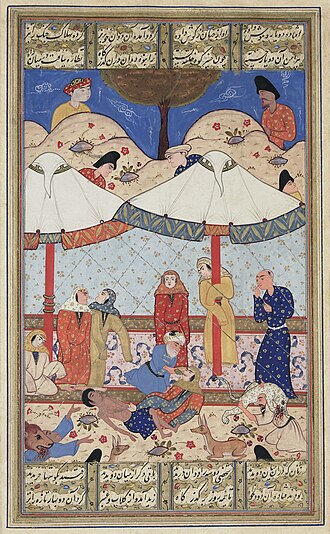
Each of our three men mistakes manhood for a conquest. But love is the journey, not the destination.
Nick Cave almost gets it. When it comes to his lover, he asks God not to intervene in anything. Not to touch a hair on her head. To leave her as she is. However, his fatal error is the one exception he allows: for God to direct her into his arms.
Aya Sophia
Every Arab I spoke to relates to these three stories. Every Arab can recount a similar story or a far-fetched fantasy they heard from a friend, family member, or public personality. But each of the three men in this story is different.
The first time Julia Roberts comes up, it is Kareem who mentions her; Bashar simply responds but does not make up a story. Instead, it is in the second time that he does, when he is looking at Damascus atop the mountain. Bashar loves Damascus, but it is hard to express love for a city, and even harder when that city has done nothing but hurt you for so long. Julia Roberts is a lot easier to love; as far-fetched as it may be, she is more likely to love Bashar back, and she has the same pretty eyes that Damascus has.
Or maybe Bashar believes in Abulafia's Prophetic Kabbalah and is simply attempting to speak his dreams into existence.
My father, on the other hand, is a materialist. He has no time for Kabbalah or for Hermetic Semiosis. Perhaps that is why he could not dare to dream. In any case, this particular memory of him, I hope, will be forgotten in due time.
Tlass, for his part, is as impotent in love as he was in his military career. The story begs us to think that he replaced the military conquests he fantasized about but never achieved with equally unrealized fictional love conquests. However, a man that small cannot dream.
The fourth story breaks the fourth wall: in writing it, perhaps I also dared to dream. Earlier in his career, Umberto Eco would have left judging that, and by extension me, as an exercise for you, the reader. A later Eco would remind you that I am my father's son, and if Eco felt particularly insistent, he might nudge you to connect the earlier appearance of Nick Cave with the one at the very end of this document.
By now, I trust you to be a wise reader. I trust you will know whether there is a choice between the two Ecos, and whether that choice is yours to make.
Either way, manhood is the pride in a new morning, born out of the light of the ones I love.
Julia Roberts, Again
Tlass's body became dirt in 2017. One of his sons, Manaf, another former commander, now lives in France. He occasionally gives lectures about Syria and its politics, and word on the street is that he hopes to be president one day.
My dad remarried and, aside from that one gaffe, continues to speak his mind, often to both our detriment.
By the end of the film, Bashar has done the unthinkable: he redeemed his name and washed away the blemishes his namesake left. Bashar means the bringer of good news, and with Julia Roberts's help, that will be all it means. Bashar appears to return to his normal life as a taxi driver. He, however, will have a happy ending.
I am pleased to say that I know Julia Roberts very well, and that when I told her about Bashar, she said she's finally found the person she was looking for all along. She will call him soon.
Into my arms, oh, Lord Into my arms, oh, Lord Into my arms, oh, Lord Into my arms